Love More
Love More
F like funny… G like geek






Patch Transcript
Image 1: A woman wearing a headset says, “Sure, I can help with that.” The caller replies, “Oh, thanks!” She asks, “Can you spell your last name, please?” He spells, “F-E-R-G-U-S-O-N.”
Image 2: She repeats, “S-E-R-V-U-S-O-M?” He tries again: “Ferguson… F like funny. E like egg. R like… library—wait! That’s L. I mean river. G like… uh… geek. U like Uranus. S like Star Trek… O like Olaf… from Frozen. N like Netflix.”
Image 3: The headset operator thinks, “Why’s he making this so hard?” The caller thinks, “What’s the problem?”
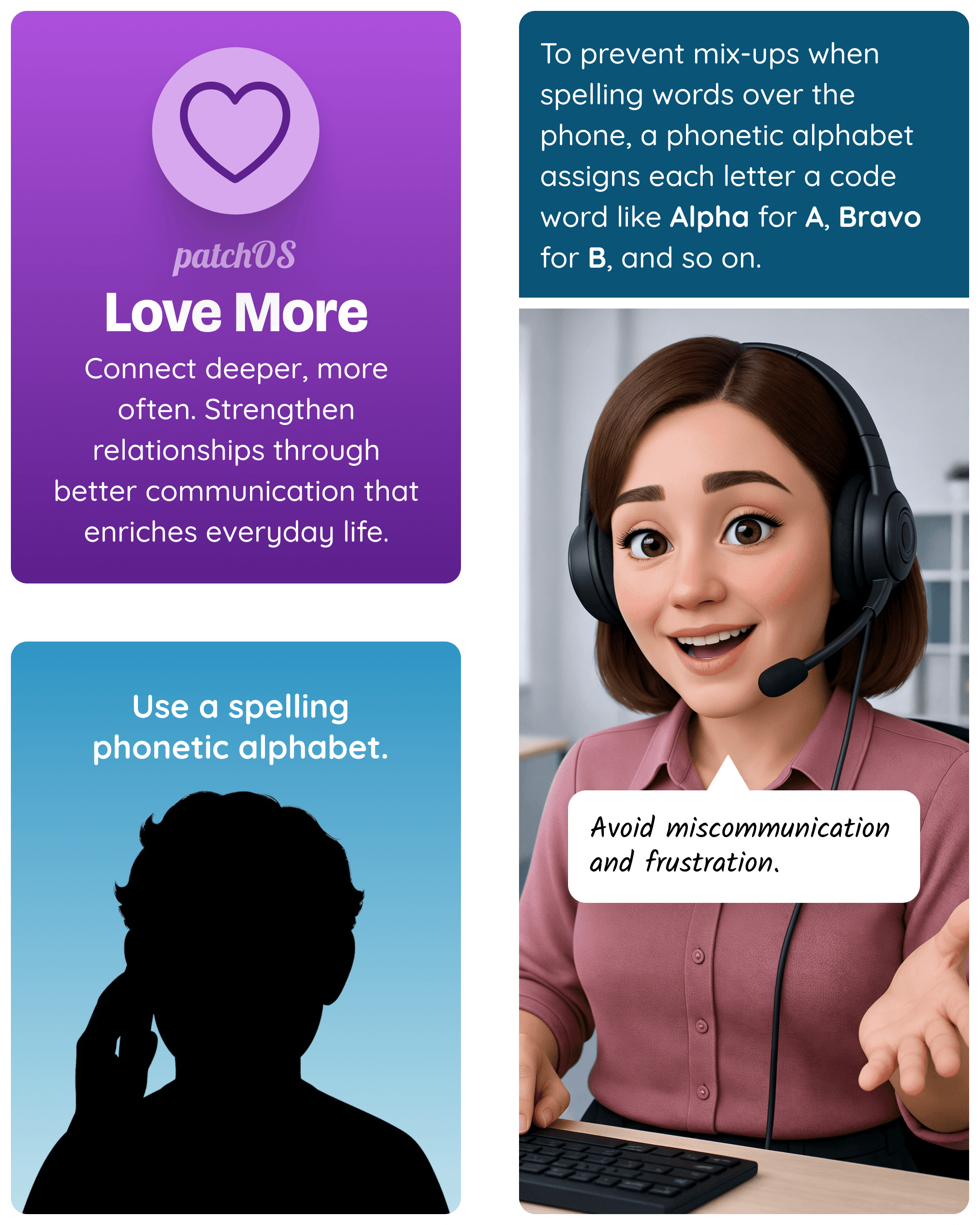
Image 4: patchOS — Love More. Connect deeper, more often. Strengthen relationships through better communication that enriches everyday life. “Use a spelling phonetic alphabet.” The caption explains, “To prevent mix-ups when spelling words over the phone, a phonetic alphabet assigns each letter a code word like Alpha for A, Bravo for B, and so on.” The operator says, “Avoid miscommunication and frustration.”
Image 5: “The NATO phonetic alphabet is the global cheat code for crystal-clear communication. Pilots, police, emergency crews, and customer service reps use it when mistakes aren’t an option—so letters don’t get lost over radios, calls, or in noisy environments.” The chart reads: A Alpha, B Bravo, C Charlie, D Delta, E Echo, F Foxtrot, G Golf, H Hotel, I India, J Juliet, K Kilo, L Lima, M Mike, N November, O Oscar, P Papa, Q Quebec, R Romeo, S Sierra, T Tango, U Uniform, V Victor, W Whiskey, X X-ray, Y Yankee, Z Zulu. “Romeo and Juliet are reunited again…”
Image 6: “The Western Union phonetic alphabet is the OG of code-word spelling. Built for telegraph operators, it predates NATO’s version and was designed to keep letters from being scrambled. It still pops up today in pockets where tradition (and a little old-school charm) hangs on.” The chart reads: A Adams, B Boston, C Chicago, D Denver, E Easy, F Frank, G George, H Henry, I Ida, J John, K King, L Lincoln, M Mary, N New York, O Ocean, P Peter, Q Queen, R Roger, S Sugar, T Thomas, U Union, V Victor, W William, X X-ray, Y Young, Z Zero. “John Adams is here… He was the 2nd US president.”
Image 7: “Spell important details.” Names, addresses, account numbers, and anything personal or important. Examples: names, Smyth; addresses, Third Street; license plates, 5B6E7K; passwords, 6MonkeysLook@Me; ID numbers, MI-32092. “Spell tricky words.” Any word that’s uncommon, technical, or hard to spell. Examples: cities, Pittsburgh and Schenectady; places, Takadanobaba and Mille Lacs; technical terms, polyethylene; rare words, synecdoche.
Image 8: “Spell lookalike sounds.” Any letter or word that could be misheard. Letters: B vs P — Barry or Perry; L vs R — Louis or Ruiz. Words: Aisle Way or Isle Way; Coal or Cole. Places: Auckland or Oakland; Oregon or Or-a-gun. Names: Steven or Stephen; Kristina or Christina. “Code words are used in 3 simple ways—here’s how.” The operator holds up three fingers. “Code words aren’t just for pilots, cops, and movie spies—people use them every day!”
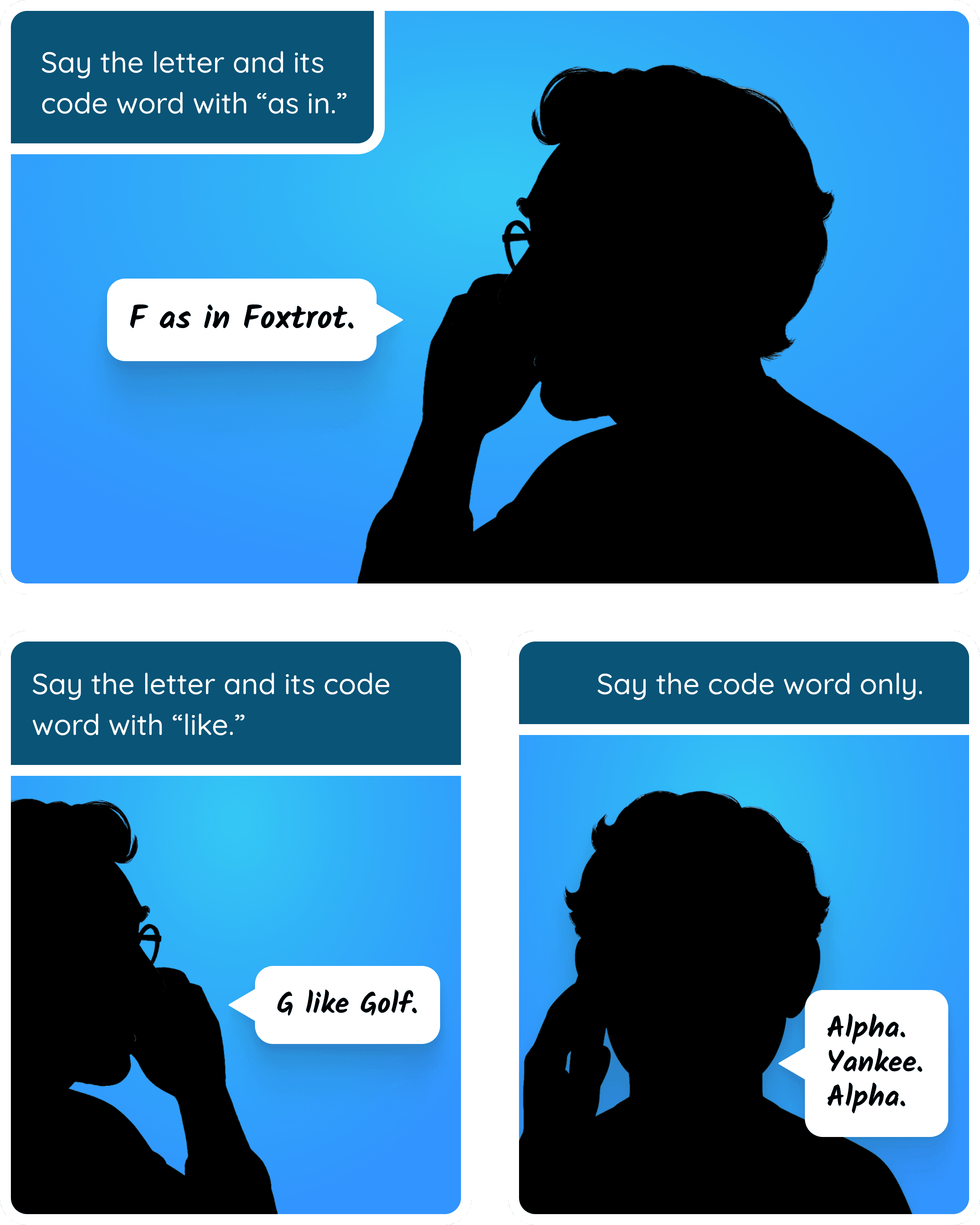
Image 9: “Say the letter and its code word with ‘as in.’” The caller says, “F as in Foxtrot.” “Say the letter and its code word with ‘like.’” He says, “G like Golf.” “Say the code word only.” He says, “Alpha. Yankee. Alpha.”
Image 10: NATO phonetic alphabet, example 1. “My address is 678 Shackleford Drive. That’s S like Sierra. H like Hotel. A-C-K-L-E-F-O-R-D Drive. Shackleford Drive.” Example 2. “My license plate number is UFW-678. That’s Uniform, Foxtrot, Whiskey, 6-7-8.”
Image 11: Western Union phonetic alphabet, example 1. “I live in Smyrna. That’s S as in Sugar, M as in Mary, Y-R-N as in New York, A. Smyrna.” Example 2. “My address is Two. Eight. Six. Beaver Ruin Road. That’s B like Boston. E-A-V like Victor. E-R. Beaver. Ruin’s spelled R-U-I-N like New York.”
Image 12: “Quiet call. Poor connection. Noisy environment—it doesn’t matter. Code words make communication smoother and less stressful. They help people hear you clearly, avoid mistakes, and feel understood.” The caller tries again: “Ferguson. F like Foxtrot. E like Echo. E like Echo. R like Romeo. G like Golf. U like Uniform. S like Sierra. O like Oscar. N like November.”
Behind This Patch
‘F like funny… G like geek’ is an understandable improvisation. The trouble is that a person on the other end of a noisy call may hear something else entirely.
A phonetic alphabet assigns a standard word to each letter so the listener can distinguish it over a noisy connection or across accents. Instead of inventing ‘F like funny’ under pressure, you can say Foxtrot and keep moving.
The International Civil Aviation Organization documents the familiar Alfa, Bravo, Charlie spelling alphabet used in aviation. Its agreed-upon words make letters easier to distinguish across languages and noisy connections.
You do not need to memorize every code word at once. Learning the letters in your name, email address, and street can make appointments, customer-service calls, and emergency communication much clearer.
This is the Love More habit at its most practical. Clear communication reduces friction and helps the person on the other end understand you the first time.
The joke starts with a clumsy phone call, but the takeaway is generous: shared words make it easier for both people to be understood.
Patch Challenge
Learn the phonetic code words for every letter in your name.
Save an official phonetic alphabet chart on your phone.
Practice spelling your email address with standard code words.
Use the standard alphabet during your next phone call instead of improvising.
Share the chart with someone who handles appointments or customer-service calls.
SUPPORT
Enjoy this Patch?
Help keep Patch Crew independent and make the next Patch possible.
PATCH PICKS
Put it into practice
Find useful tools and products selected to help you apply this Patch.
